
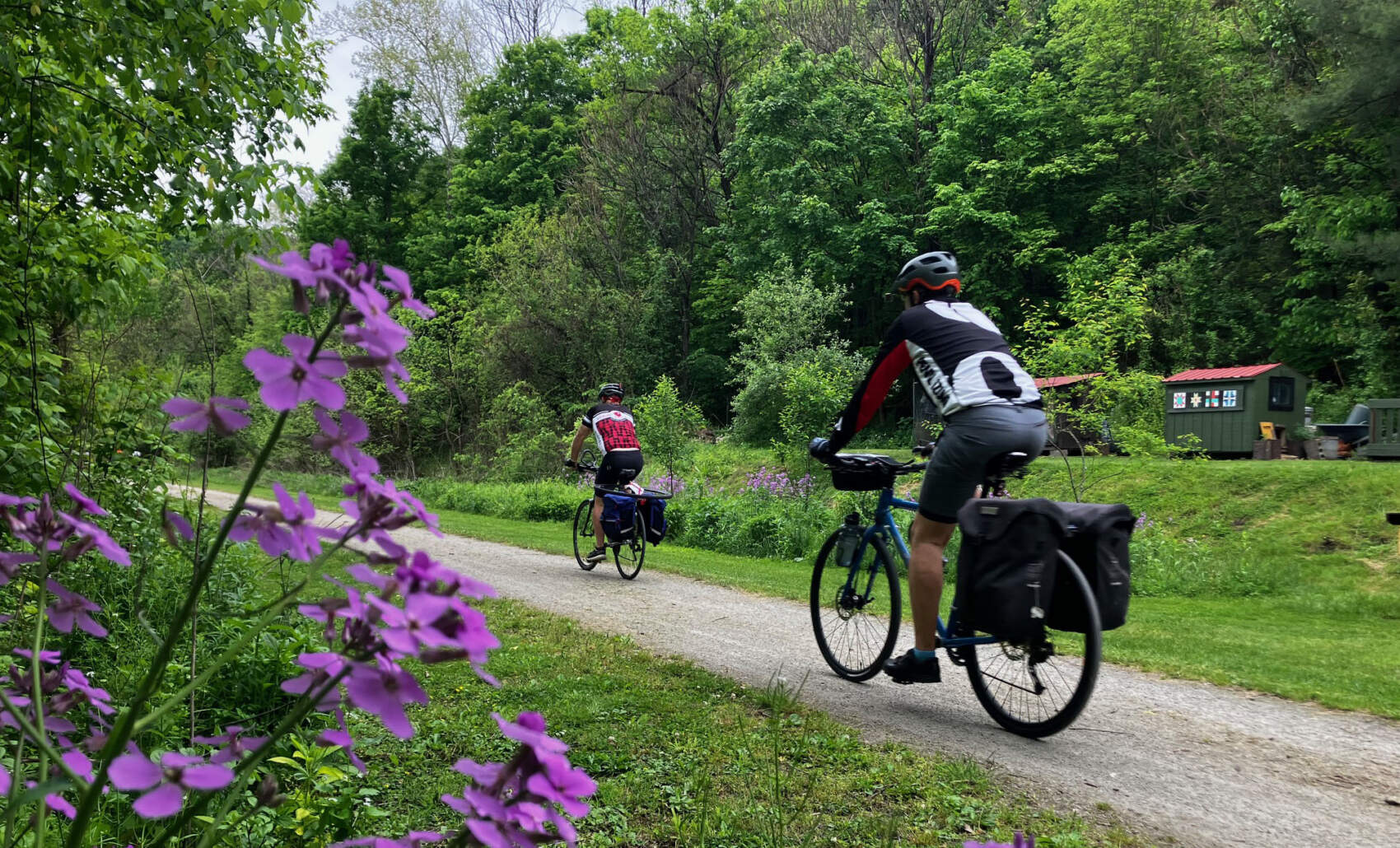
For 150 miles, the Great Allegheny Passage twists and turns along river valleys and over the Eastern Continental Divide. Bicycling, hiking, walking, and birdwatching are popular pastimes, with overnight travel among trail towns a favorite way to mark the miles. And in addition to the four deep tunnels you’ll pass through and 14 converted railroad bridges you’ll whiz over, there are all kinds of treasures out of sight of most travelers. You just have to know where to explore! Read on for some hidden gems along the GAP.
Colonial History
Make a stop at Evergreen Heritage Center, a historic farm situated on 130 acres of Federal Hill in Allegany County, Maryland, dating back to before the Revolutionary War, and recognized on the National Register for its architectural importance and its role in early colonial settlement. Visitors can tour the Evergreen Mansion, now a museum, and the 200-year-old Evergreen Barn, with its original stone foundation and plantation-era farming tools. The Evergreen Coal Trail offers a hike through historical sites, including abandoned coal mine openings, a blacksmith’s forge, a miners’ mule stable, the water tower and shed, a manually excavated water well, and the remnants of a bull wheel used to lower coal cars down a slope. The center offers educational experiences and art workshops for young people, as well as teacher training. The entrance is at mile marker 12.5 along the Great Allegheny Passage. Check their hours before you add a stop to your trip.
An Ornate Bridge
The Bollman Bridge was built in 1871 to carry the Baltimore & Ohio Railroad over Wills Creek east of Meyersdale, and in 1910 it was moved to carry a farm road over the B&O tracks west of town. Slated for demolition, the bridge was rescued and moved a second time in 2006 to serve as a bridge for the Great Allegheny Passage. It is listed on the National Register of Historic Places. At mile marker 30.4, this 81-foot cast- and wrought-iron truss bridge is one of the few remaining bridges built by pioneering builder Wendall Bollman, a builder whose patented designs were marked by ornate cast iron end pieces, lacework, and compression members. These iron bridges were easy to erect by unskilled laborers, since each part had numbers cast into it for easy identification, and the bridges could be test-assembled ahead of time. Iron diagonals radiated down from central or end towers, and everything was held together with bolts, mortise-and-tenon joints, and wrought-iron pins. Bollman’s iron bridges were eventually replaced as railroads began to use larger, heavier trains, and as steel replaced iron in bridge construction. It carries the GAP over Scratch Hill Road between Meyersdale and Frostburg.
Pinkerton Horn
At mile marker 52, instead of proceeding through the Pinkerton Tunnel, make a 90-degree turn and follow a bypass trail that curves along the Casselman River and meets back up with the Great Allegheny Passage about a mile later. This side trip takes you on an earlier alignment of the GAP, and it’s quiet and shaded, with opportunities to see herons and raptors, if you’re lucky. Pause and scramble down to the river for a look back at the Pinkerton Low Bridge. The river drops significantly in this area, and you may see folks out for a paddle in brightly-colored kayaks.
A National Natural Landmark
Botanically diverse Ferncliff Peninsula is a 100-acre National Natural Landmark in the heart of Ohiopyle State Park. Its microclimate — formed by a tight turn of the fast-moving Youghiogheny River — hosts colorful wildflowers and ancient ferns found only in warmer southern regions, including six imperiled or endangered species. Meandering footpaths featuring fossil-imprinted rocks, 200-year-old hemlocks, and cliffside lookouts onto the ever-present whitewater offer hikers a way to explore the whole peninsula, which is accessible via the Great Allegheny Passage between the Ohiopyle Low and High Bridges, near mile marker 72. Ohiopyle became a favorite destination of people living in Pittsburgh in the 1880’s as people sought fresh air and open spaces away from industrialized cities. One of the original five hotels in the areas, the Ferncliff Hotel, was on the peninsula, and eventually grew to include not only a boardwalk but also a bowling alley, tennis courts, ball fields, and fountains that hosted tourists for decades. After World War II, tourism declined and the hotels were razed. Ohiopyle resident Lillian McCahan launched an intense lobbying effort to protect Ferncliff Peninsula from subsequent commercial development. She convinced the Western Pennsylvania Conservancy and Fallingwater owner Edgar Kaufmann to purchase the peninsula in 1951, and paved the way for the Commonwealth of Pennsylvania to establish Ohiopyle State Park twenty years later.
Cedar Creek Gorge
Beautiful 479-acre Cedar Creek Park sits along the Youghiogheny River and offers water access for paddlers, boaters, and anglers right between mile markers 110 and 111 of the Great Allegheny Passage. With 20 pavilions, an overnight group camping area, a dog park, an extensive playground, three sledding and tubing runs, and an outdoor amphitheater that hosts summer concerts, Cedar Creek Park is a great outdoor recreation asset. Its central feature is a two-mile out-and-back footpath through the deeply cut Cedar Creek Gorge Interpretive Area that is noteworthy for its wooden suspension bridges, sheer cliff faces, and water cascading down natural shale steps. The foundation of an abandoned saw mill sits partway down this trail. A hiker-biker campground with Adirondack-style shelters and water serves GAP travelers at the east end of the park. Read more about Cedar Creek Gorge from an interpreter who scrambled these cliffs decades ago.
Meditative Labyrinth
Tucked next to the Pump House near mile marker 140 is a serene labyrinth built out of stone by artist Lorraine Vullo as a place to reflect on those who lost their lives during the 1892 Battle of Homestead. Spanning 68 feet, the labyrinth features more than 250 triangular stones, labeled with the names of steel mills, foundries, and blast furnaces from throughout the region. It’s a wonderful spot to rest next to the slow-moving but still-workaday Monongahela River. Watch trains pass overhead on the Pinkerton’s Landing Railroad Bridge. The Pump House itself contains a moving pictorial history of the labor-management conflict, and is curated and preserved by Rivers of Steel Heritage Corporation.
Enjoy your travels on the GAP! Plan an overnight adventure and schedule some of these stops with our interactive map or by purchasing TrailGuide: The Official Guide to Traveling the C&O Canal Towpath and Great Allegheny Passage, available at our online store.